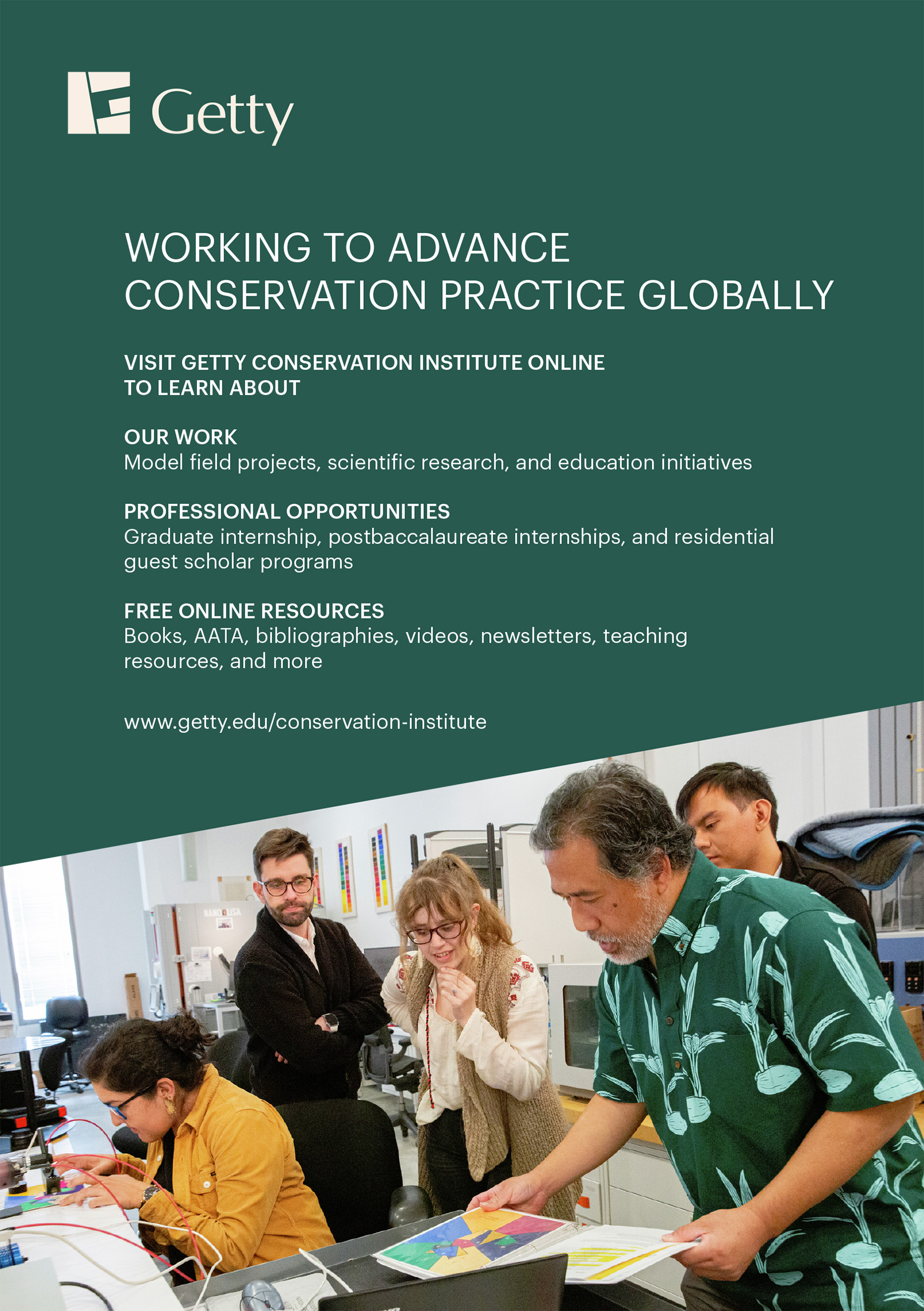
The Getty Conservation Institute serves professionals working to conserve the world’s cultural heritage through our scientific research, education and training, field projects, and sharing of our knowledge and expertise. Our work is driven by the values of excellence, innovation, leadership, collaboration, and service.
Company Description
The Getty Conservation Institute works internationally to advance conservation practice in the visual arts—objects, collections, architecture, and sites. We serve the conservation community through scientific research, education and training, field projects, and disseminating information. In all our endeavors, we create and deliver knowledge that contributes to the conservation of the world's cultural heritage.
Our Vision
We will be recognized as an independent, international center of excellence for cultural heritage conservation. We will be seen as a thought leader and innovator that deals with important issues and, through effective partnership, achieves long-term sustainable solutions in the service of the world’s cultural heritage. To achieve this, we will be an inspiring, creative work environment that encourages collaboration and interdisciplinary working.
Our Work
We seek work that addresses unsolved problems, has the potential for impact beyond a particular object or site, and will be sustainable in the long run. Success means that our work increases knowledge, provides new or improved analytical techniques and conservation strategies, and ultimately assists and serves those charged with the care of the world’s cultural heritage.
Our Work
We seek work that addresses unsolved problems, has the potential for impact beyond a particular object or site, and will be sustainable in the long run. Success means that our work increases knowledge, provides new or improved analytical techniques and conservation strategies, and ultimately assists and serves those charged with the care of the world’s cultural heritage.
Resources
Conservation Institute Publications
Over 400 titles, including scientific research, conference proceedings, case studies, project reports, bibliographies, Conservation Perspectives magazine, and works on aspects of conservation practices, available in a new searchable database.
AATA
Search 170,000+ abstracts of literature related to the preservation and conservation of material cultural heritage in this free research database.
Arches
Open-source data management platform for the heritage field.
Conservation Collection
Specialised Getty library collection of 65,000 titles addressing conservation, management, and protection of cultural property from paintings to architecture.
Opportunities
Conservation Guest Scholars
Residencies for professionals to pursue research on topics that bring new knowledge and fresh perspectives to the field of conservation. Deadline to apply for 2027–28 opportunities is October 1, 2026.
Getty Graduate Internships
Internships for graduate students pursuing careers in the visual arts. Training and work experience placements available in multiple areas at Getty. Open to students of all nationalities. Deadline to apply for 2027–28 internships is November 3, 2026.
Media
Ofelia and Rosanna Esparza: Made to Remember
Long recognized for their role in helping establish and sustain Día de los Muertos traditions in Los Angeles, the Esparzas have shaped the practice as both a communal ritual and a contemporary art form. In Ofelia and Rosanna Esparza: Made to Remember, they reflect on the ofrenda as both cultural obligation and art: a bridge between the living and the dead, and between the stories of generations past and those yet to come.
Saving Tutankhamen’s Tomb
The story of nearly 10 years of research, conservation, and improvements to preserve the Tomb of Tutankhamen. The multiyear project, a collaboration of Getty and Egypt’s Ministry of Antiquities, focused on conservation and the creation of a sustainable plan for continued management of the tomb.
Conserving the Church of Kuñotambo
Residents of Comunidad Campesina Kuñotambo in the Peruvian Andes celebrate the reopening of their church after 10 years of conservation work. This conservation project, a partnership between Getty and the Dirección Desconcentrada de Cultura de Cusco in Peru, developed new technologies and techniques to preserve earthen buildings across Latin America.
Microfading Tester
The microfading tester shines a beam of light—smaller than the tip of a pencil and 10 times brighter than the midday sun—onto individual colors on an object’s surface while measuring color change with a spectrometer. Each test is stopped before any visible fading occurs, keeping the object safe. This data helps predict how an object’s colors will respond to light, informing lighting policies that balance preservation with public access.
Acoustic Emission Monitoring
Acoustic Emission Monitoring can detect tiny cracks in materials like wood by capturing ultrasound waves and turning them into electrical signals we can see. This real-time data allows us to monitor how objects change over time, identify variations in temperature and humidity that may lead to damage, and even uncover unexpected visitors like termites.